

The cosmetics factory has evolved from a simple production facility into a sophisticated hub of scientific research, advanced technology, and sustainable practices. This comprehensive guide explores the inner workings of a modern cosmetics manufacturing plant, detailing the processes, innovations, and stringent quality controls that transform raw materials into the beauty products we trust. For brands, entrepreneurs, and consumers alike, understanding the complexities of cosmetic manufacturing is key to appreciating product quality, safety, and the industry’s future direction.
Introduction: The Engine of the Beauty Industry
When you picture a cosmetics factory, you might imagine assembly lines and mixing vats. The reality is far more complex. Today’s cosmetic manufacturing facilities are controlled environments where precision engineering, rigorous science, and stringent regulatory compliance converge. They are the critical backbone of a global beauty industry valued at over $500 billion, responsible for turning creative concepts into safe, effective, and market-ready products.
This deep dive into the modern cosmetics factory will explore its operational pillars, technological advancements, and the evolving standards that define excellence in beauty manufacturing. Whether you’re a brand looking for a manufacturing partner, a student of cosmetic science, or a curious consumer, this resource provides valuable insights into an often-overlooked part of the beauty journey.
The Anatomy of a Modern Cosmetics Factory: Core Components and Workflow
A state-of-the-art cosmetics factory is meticulously designed to ensure efficiency, cleanliness, and product integrity from receipt of raw materials to shipment of finished goods. The layout and workflow are engineered to prevent cross-contamination and maintain consistent quality.
H3: Facility Design and Controlled Environments
The physical design of a cosmetics manufacturing plant is governed by Good Manufacturing Practices (GMP). Key zones include:
-
Raw Material Warehousing: Climate-controlled areas where ingredients are quarantined, tested, and stored under specific conditions (e.g., away from light, heat, or moisture) to preserve stability.
-
Manufacturing Suites: Dedicated, hygienic rooms for different product categories (e.g., liquids, powders, anhydrous products). Air filtration systems (HEPA filters) maintain positive air pressure and minimize airborne particles. Equipment is often made of non-reactive stainless steel (304 or 316 grade) and is designed for easy cleaning (CIP – Clean-in-Place systems).
-
Quality Control (QC) Laboratories: On-site labs equipped with instruments like HPLC (High-Performance Liquid Chromatography), viscometers, pH meters, and microbial testing equipment to validate every batch.
-
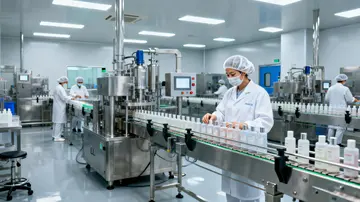
Filling and Packaging Halls: Automated, high-speed lines that fill, cap, label, and package products with minimal human contact. These areas are often segregated from manufacturing to reduce contamination risk.
The Standardized Production Workflow
A typical batch follows a regimented, documented process:
-
Dispensing: Raw materials are precisely weighed and dispensed in a dedicated area, following a verified formula sheet (master manufacturing formula).
-
Premixing & Heating/Cooling: Oil and water phases are prepared separately, often heated to facilitate mixing, and then combined using precise temperature control.
-
Emulsification: The core step for creams and lotions. High-shear mixers or homogenizers break down droplets to create a stable, uniform mixture of oil and water.
-
Cooling & Addition of Thermally Sensitive Ingredients: Fragrances, preservatives, and active ingredients (like vitamins or peptides) are added once the batch cools to a safe temperature to prevent degradation.
-
Quality Control Check (In-process): Samples are taken to check for viscosity, pH, color, and odor against specifications.
-
Deaeration: Removing air bubbles introduced during mixing to ensure product consistency and aesthetic appeal.
-
Filling & Packaging: Automated machinery fills containers, applies closures, labels, and packs into secondary packaging.
-
Final QC & Release: Finished products undergo final testing (weight check, visual inspection, sometimes stability testing) before being released for shipment.
The Science and Technology Driving Cosmetic Manufacturing
Modern cosmetic production is a science-driven endeavor. Innovations in equipment and formulation technology enable more effective, stable, and novel products.
Advanced Manufacturing Technologies
-
Automation & Robotics: From palletizing raw materials to precision filling of serums, robotics increase accuracy, speed, and hygiene while reducing labor costs and human error. Industry 4.0 principles, with IoT sensors, allow real-time monitoring of machine performance and environmental conditions.
-
Cold-Process Manufacturing: For formulas containing sensitive actives (e.g., probiotics, certain vitamins), cold processing avoids heat degradation, preserving efficacy.
-
Aseptic Processing & Fill-Finish: Inspired by pharmaceutical practices, this involves sterilizing the product and packaging separately and filling in a sterile environment. It’s crucial for preservative-free or “clean” formulations.
-
3D Printing & Personalized Beauty: Forward-thinking factories are exploring additive manufacturing for customized products, such as tailored foundation shades or bespoke skincare capsules.
Formulation Innovations and R&D Synergy
The factory floor is closely linked to the Research & Development lab. Key trends include:
-
Multifunctional Actives: Using ingredients that offer multiple benefits (e.g., a moisturizer with anti-pollution and blue-light protection properties), requiring precise incorporation methods.
-
Sustainable & Waterless Formulations: Creating solid bars, concentrated powders, or anhydrous balms reduces water weight (lowering shipping emissions) and often requires specialized, low-energy mixing equipment.
-
Encapsulation Technology: Embedding active ingredients (like retinol or vitamin C) in microscopic capsules protects them from oxidation and allows for controlled, timed release upon application. This demands specific dispersion techniques during manufacturing.
Quality, Safety, and Regulatory Compliance: The Non-Negotiables
A reputable cosmetics factory operates within a stringent framework of global regulations and standards. Compliance is not optional; it’s foundational to brand trust and consumer safety.
Adherence to Global Standards (GMP, ISO, FDA/EU Regulations)
-
Good Manufacturing Practices (GMP): The cornerstone of quality. GMP guidelines cover personnel hygiene, facility sanitation, equipment calibration, process validation, and documentation. Adherence ensures products are consistently produced and controlled to quality standards.
-
International Standards (ISO): Certifications like ISO 22716 (Cosmetics GMP) and ISO 9001 (Quality Management) provide internationally recognized frameworks for operations and are often required by major brands.
-
Regional Regulatory Bodies: Factories must comply with regulations from their market and export destinations:
-
FDA (USA): Governed by the Federal Food, Drug, and Cosmetic Act (FD&C Act). While pre-market approval isn’t required (except for color additives), facilities must be registered, and products must be safe and properly labeled.
-
EU Cosmetics Regulation (EC 1223/2009): One of the world’s strictest. Requires a Product Safety Report (CPSR), Responsible Person (RP), and complete ingredient labeling via INCI names.
-
Other Regions: China (NMPA), ASEAN, and other markets have their own specific registration and testing requirements.
-
Rigorous Quality Control and Stability Testing
QC is integrated at every stage:
-
Incoming Raw Material Testing: Certificates of Analysis (CoA) are verified. Ingredients may be tested for identity, purity, and microbial load.
-
In-Process Controls: Checks for weight, pH, viscosity, and specific gravity during manufacturing.
-
Finished Product Testing: Includes:
-
Microbiological Testing: Ensures products are free from harmful pathogens and have adequate preservative efficacy (Challenge Testing).
-
Stability Testing: Products are stored under various conditions (elevated temperature, humidity, freeze-thaw cycles) for months to predict shelf life and ensure packaging compatibility.
-
Performance Testing: In-vitro tests for SPF, anti-aging claims, etc.
-
-
Comprehensive Documentation: Every step is documented in a Batch Manufacturing Record (BMR), creating a traceable history for each product unit—essential for audits and potential recalls.

Sustainability and Ethical Considerations in Cosmetic Manufacturing
The modern cosmetics factory is increasingly evaluated on its environmental and social impact. Leading manufacturers are integrating sustainability into their core operations.
Green Chemistry and Sustainable Sourcing
-
Bio-based & Upcycled Ingredients: Utilizing ingredients derived from renewable resources or made from food/agricultural by-products (e.g., grape seed oil from winemaking waste).
-
Green Chemistry Principles: Designing formulations that use less energy, generate less waste, and employ safer, biodegradable surfactants and emulsifiers.
-
Ethical and Traceable Supply Chains: Partnering with suppliers who provide fair trade ingredients, avoid deforestation (e.g., palm oil), and ensure biodiversity conservation.
Eco-Conscious Operations and Waste Reduction
-
Energy and Water Efficiency: Installing solar panels, using energy-efficient motors, and implementing water recycling systems in cleaning processes.
-
Zero-Waste-to-Landfill Initiatives: Repurposing production waste. For example, off-spec product batches can be diverted for conversion into industrial biofuels or fertilizers.
-
Sustainable Packaging Partnerships: Working with brands to design for recyclability, use PCR (Post-Consumer Recycled) materials, and reduce overall packaging weight and complexity.
The Future of the Cosmetics Factory: Trends and Predictions
The factory of the future is smart, agile, and deeply integrated with the digital world.
The Rise of Smart Factories and AI Integration
-
Digital Twins: Creating virtual models of the production line to simulate processes, optimize workflows, and predict maintenance needs without disrupting physical operations.
-
AI-Powered Predictive Analytics: Machine learning algorithms analyze production data to forecast machine failures, optimize batch sizes, and even predict raw material quality variations.
-
Blockchain for Provenance: Using blockchain technology to create immutable, transparent records of an ingredient’s journey from farm to formula, boosting supply chain transparency for consumers.
On-Demand Manufacturing and Hyper-Personalization
-
Flexible, Small-Batch Production: As the market fragments into niche brands and direct-to-consumer models, factories will need modular equipment that can quickly switch between small runs of diverse products cost-effectively.
-
Mass Customization: Factories may evolve to offer “beauty-on-demand,” where algorithms adjust base formulas in real-time to create personalized shades or skincare based on individual consumer data provided by brands.

Conclusion: The Strategic Heart of Beauty Brands
Choosing the right cosmetics factory is one of the most critical decisions a beauty brand can make. It is a partnership that dictates product quality, scalability, regulatory compliance, and brand reputation. The modern manufacturer is no longer just a service provider but a strategic partner equipped with scientific expertise, technological capability, and a commitment to ethical and sustainable practices.
For brands looking to collaborate with a factory, due diligence is paramount. Audit their certifications, inspect their facilities, evaluate their R&D capabilities, and assess their cultural alignment with your brand’s values on sustainability and innovation.
The evolution of the cosmetics factory mirrors the evolution of the beauty industry itself—moving towards greater transparency, higher efficacy, and a deeper sense of responsibility. As consumers become more knowledgeable and demanding, the factories that embrace science, sustainability, and smart technology will be the ones shaping the future of beauty.
Ready to explore manufacturing? Look for partners who openly discuss their compliance, technology, and sustainability journey—a sign of a modern, trustworthy cosmetics factory.