

The Guangzhou Cosmetics Factory is not only the heart of China’s beauty industry but also an indispensable part of the global cosmetics supply chain. As one of the world’s largest cosmetic production bases, Guangzhou boasts over 40 years of industrial accumulation, forming a complete industry chain encompassing raw material supply, R&D design, manufacturing, packaging, and logistics. This article will provide an in-depth exploration of the unique advantages, industrial ecosystem, digital transformation, and future development trends of the Guangzhou Cosmetics Factory, offering comprehensive and professional insights for brands seeking cooperation and industry observers.
Comprehensive Analysis of the Guangzhou Cosmetics Industrial Ecosystem
Geographical Advantages and Historical Accumulation of Industrial Clusters
The rise of the Guangzhou Cosmetics Factory is not accidental but the result of the combined effects of geographical location, policy support, and historical opportunities. As the forefront of China’s reform and opening-up, the Pearl River Delta region began attracting foreign-invested cosmetics enterprises as early as the 1980s. With its proximity to Hong Kong and Macao, convenient port transportation, and well-developed trade infrastructure, Guangzhou quickly became the preferred production base for international cosmetic brands entering the Chinese market.
Currently, Guangzhou is home to over 2,000 licensed cosmetics manufacturers, accounting for nearly one-third of the national total. These factories are mainly concentrated in Baiyun District, Huadu District, and Conghua District, forming several distinctive industrial clusters. Baiyun District primarily hosts small and medium-sized OEM/ODM factories known for their flexibility, suitable for small-batch orders. Huadu District aggregates many large-scale modern factories with production lines and R&D capabilities meeting international standards. Conghua District leverages its ecological advantages to develop natural plant extraction and green cosmetics production.
This cluster-based development not only reduces logistics and collaboration costs for enterprises but also facilitates knowledge spillover and technology diffusion, enabling the Guangzhou Cosmetics Factory to respond rapidly to market changes and keep pace with global beauty trends.
Complete Supply Chain System and Specialized Division of Labor
One of the core competitive strengths of the Guangzhou Cosmetics Factory lies in its complete and efficient supply chain system. On the raw material front, Guangzhou and its surrounding areas host branches of major global cosmetic raw material suppliers, as well as numerous domestic specialty raw material producers. Whether for basic emulsifiers, humectants, or high-end active ingredients and natural extracts, sourcing can typically be resolved within a 50-kilometer radius.
In the production sector, the Guangzhou Cosmetics Factory has developed a high degree of specialized division of labor. Some factories specialize in specific categories, such as face masks, lipsticks, or skincare products; others excel in special processes like freeze-drying technology, micro-emulsification, or nano-encapsulation. This division of labor allows each factory to accumulate deep expertise in its niche area, forming technological barriers.
More importantly, Guangzhou possesses a well-developed supporting industry ecosystem, including service providers for mold manufacturing, packaging design, printing, and testing/certification. A brand company can complete the entire process from concept to finished product within Guangzhou. This one-stop service capability is extremely rare globally and remains a key factor continuously attracting international brands to the Guangzhou Cosmetics Factory.
Analysis of the Core Competitiveness of Guangzhou Cosmetics Factories
R&D Innovation Capability and Rapid Response Mechanisms
Contrary to traditional perceptions, the modern Guangzhou Cosmetics Factory is no longer a mere processing workshop but possesses strong R&D and innovation capabilities. Leading factories invest 3-5% of their annual revenue in R&D, establishing comprehensive systems covering basic research, formula development, stability testing, and efficacy evaluation.
The R&D advantages of the Guangzhou Cosmetics Factory are evident in several aspects: First, in-depth research on the skin characteristics of Asians, accumulating a vast amount of localized data. Second, the modern application of traditional Chinese herbal ingredients, such as extraction and stabilization technologies for ginseng, lingzhi (reishi mushroom), and pearl. Third, keen捕捉 of market trends, enabling rapid development of products aligned with popular movements.
This combination of R&D capability and rapid response mechanisms allows the Guangzhou Cosmetics Factory to support brand owners in implementing flexible production models characterized by “small batches, multiple varieties, and fast turnover.” From concept proposal to sample production, the fastest completion time can be 2-3 weeks; from order confirmation to batch shipment, conventional products can be completed within 30-45 days—a speed far exceeding that of similar factories in Europe and America.
International Standard Production Quality Systems
With increasing global cosmetics regulation and rising consumer demands for product quality, the Guangzhou Cosmetics Factory has significantly upgraded its production quality systems over the past decade. Currently, leading factories generally hold international certifications such as ISO22716, GMPC, and ISO9001, with some even meeting pharmaceutical-grade production standards.
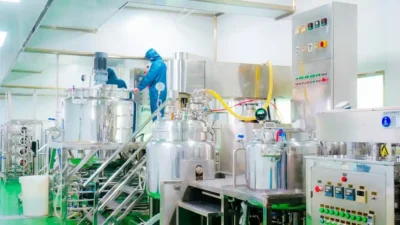
These factories have made substantial investments in hardware facilities, constructing 100,000-grade or even 10,000-grade clean rooms, equipped with fully automated production lines, intelligent warehousing systems, and traceable quality management systems. Every step from raw material receipt to finished product dispatch is strictly monitored and recorded, ensuring product safety and consistency.
Simultaneously, the Guangzhou Cosmetics Factory is actively introducing advanced international management concepts and technologies, such as lean manufacturing and Six Sigma, continuously improving production efficiency and product yield rates. This relentless pursuit of quality has enabled “Made in Guangzhou” cosmetics to enter high-end markets like Europe, America, and Japan, gaining recognition.
Digital Transformation and Smart Manufacturing Upgrade
Application of Industry 4.0 in Cosmetics Production
Facing the dual challenges of rising labor costs and growing demand for personalization, the Guangzhou Cosmetics Factory is actively advancing digital transformation and smart manufacturing upgrades. Leading factories have already built “smart factories,” achieving digitization, networking, and intellectualization of production processes.
Specifically, this transformation manifests at several levels: On production lines, automated filling systems, robotic packaging lines, and AGV logistics vehicles have been introduced, significantly reducing manual intervention. In quality control, machine vision inspection systems and online monitoring equipment are applied, enabling real-time quality monitoring. In data management, deep integration of MES (Manufacturing Execution Systems) and ERP (Enterprise Resource Planning) systems has been established, achieving visual management of the entire production process.
The application of these technologies not only improves production efficiency and product consistency but, more importantly, makes small-batch customized production feasible. Through digital systems, the Guangzhou Cosmetics Factory can switch between producing different products without halting production, meeting market demands for personalized and limited-edition cosmetics.
Digital Supply Chain and Flexible Production Capacity
Beyond digitization in production, the Guangzhou Cosmetics Factory is also building digital supply chain systems. Blockchain technology enables raw material traceability and supply chain transparency; IoT devices allow real-time monitoring of storage environments and logistics status; big data analytics help predict raw material price fluctuations and market trends, optimizing procurement decisions.
The combination of this digital supply chain with flexible production capacity enables the Guangzhou Cosmetics Factory to better cope with market uncertainties. During the pandemic, many factories could adjust production lines in a short time to manufacture urgently needed products like disinfectants and hand sanitizers. When the market recovered, they could quickly return to cosmetics production, capturing the rebound in consumption.
Digital transformation has also altered the collaboration model between the Guangzhou Cosmetics Factory and brand owners. Through cloud platforms, brand owners can view order progress, quality data, and inventory status in real-time, even participating remotely in product debugging. This transparent and efficient collaboration method significantly enhances mutual trust and the depth of cooperation.
How to Select and Evaluate a Guangzhou Cosmetics Factory
Certification and Compliance Considerations
For brand owners seeking cooperation, the primary considerations when selecting a Guangzhou Cosmetics Factory are its certifications and compliance. At a basic level, the factory must hold a “Cosmetics Production License,” a mandatory requirement under Chinese law. Additionally, international certifications like ISO22716 (Cosmetics Good Manufacturing Practices) and GMPC (Good Manufacturing Practice for Cosmetics) serve as important references.
It is noteworthy that compliance requirements vary across different markets. If products are planned for export to Europe and America, it is preferable for the Guangzhou Cosmetics Factory to possess relevant qualifications such as FDA registration and EU CPNP notification. For the Japanese market, understanding Japanese cosmetic standards is necessary. A responsible Guangzhou Cosmetics Factory will proactively inform clients of relevant requirements and provide necessary documentation support.
Beyond the certificates themselves, more crucial is the factory’s emphasis on compliance in daily operations. This includes compliance assessment of raw materials, standardized preparation of Product Information Files (PIF), and规范性 of product stability testing. Brand owners can request the Guangzhou Cosmetics Factory to provide relevant case studies to understand its capability in handling complex compliance issues.
Assessing the Match Between Production Capacity and R&D Strength
Selecting a Guangzhou Cosmetics Factory should not be based solely on scale but on the match between its production capacity and the brand’s needs. For startup brands, it may be necessary to find factories specializing in small-batch, flexible production. For established brands, evaluating the factory’s large-scale production capacity, supply chain stability, and cost-control capabilities is required.
R&D strength is another key consideration. An excellent Guangzhou Cosmetics Factory should possess an independent R&D team, well-equipped laboratories, and a rich formula library. Brand owners can propose specific product concepts or technical challenges to observe the factory’s problem-solving capabilities. For example, developing a product with specific texture, efficacy, or stability requirements to see if the Guangzhou Cosmetics Factory can provide scientifically sound solutions.
On-site visits are indispensable for Guangzhou Cosmetics Factory evaluation. During inspections, attention can be paid to details such as workshop cleanliness, equipment maintenance status, operational规范 of employees, and the strictness of quality control. These often reflect the truest indication of the factory’s management level.
Future Development Trends of Guangzhou Cosmetics Factories
Sustainable Development and Green Manufacturing Transformation
With increasing global environmental awareness and the proposal of “Dual Carbon” goals (carbon peak and neutrality), the Guangzhou Cosmetics Factory is facing both pressure and opportunities for green transformation. Leading factories have begun promoting sustainability from multiple dimensions: in raw material selection, prioritizing renewable natural ingredients and certified sustainable raw materials; in the production process, reducing energy and water consumption through technological improvements, implementing wastewater treatment and recycling; in packaging, adopting recyclable materials and reducing excessive packaging.
This transformation is not only a response to social responsibility but also a market necessity. An increasing number of international brands are making sustainability a key criterion for supplier selection, requiring the Guangzhou Cosmetics Factory to provide environmental indicators such as carbon footprint and water footprint data. Guangzhou cosmetics factories still have room for improvement in this area, but some benchmark enterprises have already won the favor of high-end clients through green manufacturing.
In the future, the Guangzhou Cosmetics Factory may develop towards a “Green Industrial Park” model, achieving circular economy at the park level through centralized heating, wastewater treatment, and resource utilization of waste. This model can not only reduce the environmental costs for individual factories but also create environmental advantages for the industrial cluster.
Supply Chain Reshaping in the Context of Cross-Border E-commerce and New Retail
The rise of cross-border e-commerce and the development of new retail models are profoundly changing the supply chain landscape of the cosmetics industry. For the Guangzhou Cosmetics Factory, this presents both challenges and opportunities. On one hand, cross-border e-commerce requires factories to handle small-batch, high-frequency orders and ship directly to overseas consumers or e-commerce warehouses. On the other hand, new retail emphasizes online-offline integration, demanding factories possess the ability to respond quickly to market changes.
To adapt to these changes, the Guangzhou Cosmetics Factory is adjusting in several aspects: Firstly, establishing flexible supply chains capable of supporting orders ranging from dozens to hundreds of thousands of units. Secondly, setting up overseas warehouses and cooperating with logistics companies to shorten delivery times to overseas consumers. Thirdly, creating digital interfaces to connect directly with brands’ e-commerce platforms and CRM systems, enabling data-driven production planning.
Notably, cross-border e-commerce has also accelerated the branding process of the Guangzhou Cosmetics Factory. Some capable factories are beginning to develop their own brands, targeting overseas consumers directly through cross-border e-commerce channels. These “factory brands” demonstrate unique competitiveness in the international market, leveraging precise control over product costs and rapid product iteration capabilities.
the Guangzhou Cosmetics Factory is at a critical juncture of transformation and upgrading. Evolving from traditional processing to smart manufacturing, from cost competition to value creation, and from passive order-taking to proactive service, this industrial cluster is undergoing profound changes. For global beauty brands, the Guangzhou Cosmetics Factory is no longer just a simple outsourcing option for production but can become an innovative partner for deep collaboration. With the enhancement of technological capabilities and innovation in service models, the Guangzhou Cosmetics Factory is destined to play an increasingly important role in the global beauty industry.
If you are looking for a reliable cosmetics partner or wish to gain a deeper understanding of the specific capabilities of the Guangzhou Cosmetics Factory, we recommend conducting on-site visits and engaging in in-depth technical exchanges and需求对接 with potential partners. The right Guangzhou Cosmetics Factory can not only meet your production needs but also become a strong support for your brand development.