

The Panorama of Guangzhou’s Cosmetics Industry: Why Global Brands Choose Guangzhou Manufacturing?
Industrial Cluster Advantage: The “World Factory” of Cosmetic Manufacturing in China
The Guangzhou and surrounding Pearl River Delta region hosts over 60% of China’s cosmetic manufacturing enterprises, forming a complete industrial chain from raw material supply, packaging production, R&D design to finished product manufacturing, testing, and certification. This deeply integrated industrial cluster enables highly competitive production cycles and cost control, while maintaining flexible production capabilities suitable for both low Minimum Order Quantities (MOQ) and large-scale production.
This clustering effect not only reduces logistics and procurement costs but, more importantly, creates an environment for knowledge and technology spillover. The close connections among factories and suppliers facilitate the rapid dissemination of industry best practices, keeping Guangzhou’s cosmetic manufacturing standards at the industry forefront.
International Certifications & Quality Standards: The Passport to Global Markets
Leading Guangzhou cosmetics factories commonly hold international certifications such as ISO22716 (Cosmetics Good Manufacturing Practices), GMPC (US/EU Cosmetic Good Manufacturing Practices), and ISO9001 Quality Management Systems. These certifications are not just proof of production capability but are essential qualifications for products entering global markets like Europe, America, Southeast Asia, and the Middle East.
Notably, some leading factories in Guangzhou have proactively established compliance systems aligned with China’s new “Cosmetics Supervision and Administration Regulations,” covering entire processes including product filing, safety assessment, and efficacy claims. This forward-looking compliance provides partner brands with significant regulatory risk mitigation, especially under China’s increasingly stringent regulatory environment.
Analysis of Core Competitiveness of Guangzhou Cosmetics Factories
Complete Supply Chain & Raw Material Innovation Capabilities
The core advantage of Guangzhou cosmetics factories lies not only in production capacity but in their vertically integrated supply chain management. From basic ingredients to specialty actives, Guangzhou factories have established direct partnerships with global top-tier suppliers (like BASF, Symrise, Givaudan) while nurturing a group of excellent local raw material suppliers.
In recent years, Guangzhou factories have shown outstanding performance in ingredient innovation, particularly in applications of natural plant extracts, traditional Chinese herbal cosmetic ingredients, and microbial fermentation technology. This innovation at the raw material level enables partner brands to develop products with differentiated competitive advantages, moving beyond simple homogeneous competition.
R&D Capabilities & Formulation Technology Reserves
Modern Guangzhou cosmetics factories have evolved from mere “contract manufacturers” to “R&D + Production” comprehensive service providers. Leading factories typically have independent R&D centers equipped with professional instruments like stability testers, High-Performance Liquid Chromatography (HPLC), microbiology labs, and experienced formulation teams.
These R&D teams are not only familiar with international trends but also deeply understand the skin characteristics of Asian consumers, accumulating specialized formulation libraries for specific skin types like oily, sensitive, and acne-prone skin. For brands, this translates to shorter product development cycles and higher market success rates, especially for product lines targeting Asian markets.
How to Choose the Right Guangzhou Cosmetics Factory: A Decision-Making Guide for Brands
Six Key Dimensions for Factory Evaluation
-
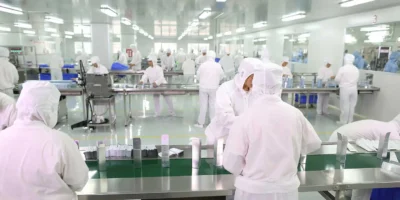
Production Capacity & Equipment Level: Assess whether the factory has automated filling lines, 100,000-class clean rooms, advanced emulsification equipment, etc. Also, understand the factory’s peak capacity and flexible production capabilities to ensure alignment with brand needs at different development stages.
-
R&D & Customization Capabilities: Evaluate the factory’s R&D team size, number of formulation reserves, and customization service processes. An excellent factory should provide full-cycle product solutions from market insight and concept development to formulation design and packaging suggestions.
-
Quality Control System: Deeply understand the factory’s specific execution standards for raw material inspection, in-process quality control, finished product testing, etc. Request to review recent third-party test reports and quality audit records.
-
Compliance & Documentation Support: Verify the factory’s compliance qualifications for target markets and its ability to provide complete product dossiers, safety assessment reports, compliant label reviews, and other critical documentation support.
Matching Strategies for Different Factory Types
-
Startup Brands: Should choose factories friendly to small-to-medium orders, focusing on design/sampling capabilities, low MOQs, and flexible payment terms.
-
Established Brands Expanding New Product Lines: Prioritize factories with specialized expertise in specific categories (e.g., masks, serums, color cosmetics).
-
International Brands for Local Production: Need to emphasize the factory’s bilingual service capabilities, international standard compliance, and cross-border logistics experience.
Modern Partnership Models: Relationships Beyond Traditional OEM/ODM
From Contract Manufacturing to Co-Creation: Value-Sharing New Partnerships
Forward-thinking Guangzhou cosmetics factories are transforming from passive production executors to strategic partners in brand development. This new model manifests at multiple levels: joint market trend research, shared consumer insights, collaborative product innovation, and even co-investment in developing exclusive ingredients or technologies.
For example, some factories have established “innovation lab” mechanisms with brand partners, regularly sharing latest R&D achievements and consumer testing data, beginning deep collaboration at the product concept stage. This co-creation model significantly reduces product development risks and time-to-market for brands, especially suitable for highly competitive niche markets.
Digital Integration: Supply Chain Transparency & Collaborative Innovation
Leading factories implement digital management of the entire production process through ERP, MES, and other systems. Brand partners can access real-time information on order progress, quality testing data, inventory status, etc., through dedicated portals. This transparency not only builds trust but, more importantly, enables efficient coordination between supply and demand ends.
Digital tools also extend to product development. Some factories have developed virtual formulation labs, 3D packaging design platforms, and other tools, making remote collaborative development possible and greatly facilitating cooperation between international brands and Guangzhou factories.
Analysis of Successful Case Studies & Industry Trend Outlook
Successful Localization Practices of International Brands
A French skincare brand collaborated with a GMPC-certified Guangzhou factory to develop a skincare series specifically for Asia’s humid climate. Based on research into Asian consumers’ skin microbiome, the factory’s R&D team proposed an innovative “prebiotic stabilization” formulation concept. The final product achieved unexpectedly strong reception in China and Southeast Asian markets.
The insight from this case: Successful collaboration is the chemical reaction between international brand expertise and local factory market insight. The deep understanding of regional consumer habits, climatic influences, and usage preferences by Guangzhou factories becomes an indispensable component of international brands’ localization strategies.
Sustainability & Ethical Manufacturing: An Irreversible Industry Trend
Awakening environmental consciousness is profoundly transforming cosmetic manufacturing. Forward-looking Guangzhou factories have implemented sustainability initiatives across multiple dimensions:
-
Green Production: Implementing water recycling systems, solar power, waste reduction plans.
-
Eco-Friendly Packaging: Developing recyclable, biodegradable, reusable packaging solutions.
-
Ethical Sourcing: Establishing ingredient traceability systems to ensure sustainable sourcing of key materials like palm oil and pulp.
For brands, choosing factories with substantial investment in these areas not only reduces environmental risks but also directly enhances brand ESG value, meeting the growing consumer demand for ethical consumption.
Practical Steps to Begin Cooperation & Frequently Asked Questions
Five-Step Method to Initiate Partnership
-
Requirement Clarification Stage: Prepare a detailed product requirement document, including key information like target market, price range, key ingredients, expected sales volume.
-
Factory Screening Stage: Screen 3-5 potential factories based on requirements, conduct initial inquiries, and qualification reviews.
-
On-Site Inspection Stage: Conduct physical (or virtual) inspections of shortlisted factories, communicating directly with key teams.
-
Sampling & Testing Stage: Request factories to provide samples based on base formulations for internal testing and small-scale market testing.
-
Contract Negotiation Stage: Clarify cooperation terms, especially regarding MOQ, payment terms, intellectual property protection, etc.
Frequently Asked Questions on Cooperation
Q: What is the typical Minimum Order Quantity (MOQ) when cooperating with Guangzhou factories?
A: This depends on product type and factory positioning. Standard products like masks or toners may have MOQs as low as 5,000-10,000 pieces, while special formulations or complex packaging may require higher MOQs. Some factories offer “startup support programs” to lower initial thresholds for new brands.
Q: How long does the typical product development cycle take?
A: Modifying existing formulations from a factory’s library may take only 4-8 weeks; developing entirely new formulations requires 12-20 weeks, including necessary processes like formulation R&D, stability testing, and safety assessment. Packaging design and production also affect the overall timeline.
Q: How to protect brand formulations and intellectual property?
A: Reputable factories sign strict Non-Disclosure Agreements (NDAs) and implement both physical and digital segregation measures. It’s advisable to clearly define IP ownership, breach penalties, etc., in the cooperation agreement. For core confidential formulations, consider protective strategies like phased provision of ingredient information.