

In the beauty industry, there is a saying: “Marketing determines your altitude, but the supply chain determines your distance.”
For any beauty brand, finding a High-quality cosmetics factory is not just about finding a place to manufacture products; it is about finding a business partner capable of delivering safety, compliance, and market competitiveness. But among thousands of suppliers claiming to be “top-tier manufacturers,” how do you strip away the marketing fluff and use hard metrics to filter out the true industry leaders?
This article deconstructs the core DNA of a high-quality factory, helping you make the most precise decisions in the global supply chain.
1. Redefining “High-Quality”: Beyond Basic Hygiene
What Defines a High-Quality Cosmetics Factory?
Many people’s understanding of a “good factory” stops at “clean and tidy.” However, in the market environment of 2024, cleanliness is merely the baseline. A truly High-quality cosmetics factory must possess the systematic capability to transform complex chemical formulas into stable, commercial products.
1. International Certification Systems: The Ticket to Entry
Critical Certifications (GMP, ISO, and FDA) Certificates are not just decorations on a wall; they are a direct reflection of a factory’s management system.
-
GMPC (Good Manufacturing Practice of Cosmetic Products): This is the foundation. Whether it is the US FDA standards or the EU ISO 22716 standards, GMPC ensures the consistency and control of the production process.
-
ISO 9001 & ISO 14001: The former represents the maturity of the quality management system, while the latter represents environmental responsibility. European and American buyers place particular importance on ISO 14001 because it ties into the brand narrative of “Sustainability.”
-
Expert Insight: The “de-AI’d” tip here is: Don’t just look at the certificate; check the issuing authority (authoritative bodies like SGS or Intertek carry the most weight) and verify if the certificate is currently valid.
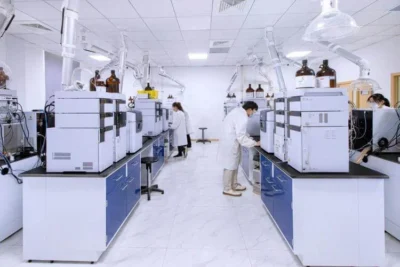
2. The Real Strength of the R&D Lab
The Core of Innovation: R&D Capabilities Mediocre factories are merely “formula movers,” while high-quality factories are “formula developers.”
-
Formula Reserves: Top-tier factories typically hold a library of over 3,000-5,000 mature formulas, allowing them to respond quickly to market trends (such as “Skin Cycling” or “Clean Beauty”).
-
Customization Ability: They don’t just tweak fragrance and color; they can customize deeply, from emulsification systems and preservative systems to transdermal delivery technologies for active ingredients.
-
Testing Equipment: Observe if their lab is equipped with high-end equipment for stability testing and ingredient analysis, such as HPLC (High-Performance Liquid Chromatography), Viscometers, and Centrifuges.
2. Production Transparency: Total Control from Raw Material to Filling
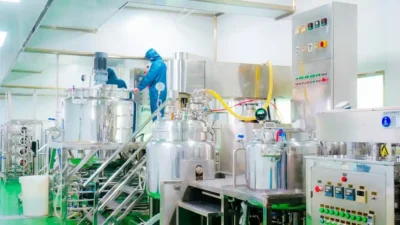
Inside the Production Line: Traceability and Control
When you search for a High-quality cosmetics factory on Google, what you are really searching for is “Traceability.” If a factory cannot tell you the specific source of their raw materials, they are a ticking time bomb for your brand.
1. Globalization of Sourcing and Ethics
Raw Material Sourcing and Supply Chain Ethics Top factories usually establish long-term partnerships with global raw material giants (like BASF, Symrise, DSM, Givaudan).
-
COA (Certificate of Analysis): Every batch of incoming raw material must have a corresponding COA report.
-
Refusing “Angel Dusting”: High-quality factories refuse to produce products with “concept spiking” (adding trace amounts solely for label claims) because it damages long-term reputation. They will advise brands to use active ingredients at efficacious levels—this is responsible behavior toward both the brand and the consumer.
2. Rigorous QC (Quality Control) Protocols
Rigorous Quality Control Protocols All High-quality cosmetics factories share one common trait: The power of the QA (Quality Assurance) department overrides the Production department.
-
Physicochemical Testing: pH value, viscosity, specific gravity, centrifugal stability.
-
Microbial Testing: Total plate count, mold, and yeast. This is critical; microbial contamination is the number one reason for cosmetic recalls globally.
-
Challenge Test: This simulates the contamination a product might face during consumer use, ensuring the preservative system remains effective after the product is opened.
3. OEM vs. ODM: Choosing the Right Collaboration Model
Choosing the Right Partnership: OEM vs. ODM
Even if you find a high-quality factory, choosing the wrong cooperation model can lead to project failure. You need to match the model to your brand’s stage of development.
1. OEM (Original Equipment Manufacturer): For Formula Owners
When to Choose OEM Services If your brand owns exclusive core formula technology or has its own R&D Director, OEM is the best choice.
-
Advantage: You own the Intellectual Property (IP); the factory is solely responsible for production processing.
-
Requirements for the Factory: Here, you value the factory’s Scalability and Process Precision. A good OEM factory can precisely replicate the sensory feel and efficacy of your lab samples, keeping deviations within an extremely small margin.
2. ODM (Original Design Manufacturer): One-Stop Solutions
When to Choose ODM Solutions For startups or cross-industry brands, ODM is a sharp tool for entering the market quickly.
-
Advantage: The factory provides a full-service package, from brand planning and packaging design to formula development and shipping.
-
Warning: When choosing ODM, be sure to clarify formula ownership. Many low-end factories use “public mold” formulas (white labeling), leading to severe product homogenization in the market. A High-quality cosmetics factory offering ODM services will apply a “Signature Touch”—distinctive micro-adjustments—even when using mature formulas.
4. Red Flags: Identifying Risks in Manufacturing
Red Flags: Identifying Risks in Manufacturing
To make this article practically valuable, we need to expose some industry “unspoken rules.” Not everyone with a fancy booth at a trade show or a decorated Alibaba profile is a good factory.
1. Communication Traps
Communication Barriers and Transparency
-
Beware the “Yes Man”: If you ask a factory, “Can you make this specific texture?” and they immediately answer, “Yes, no problem, we can do anything,” this is usually a dangerous signal.
-
Professional Refusal: A real High-quality cosmetics factory knows how to say no. They will tell you: “This ingredient is unstable at this pH level; we suggest switching to…” This kind of technical feedback is far more valuable than blind promises.
2. The Logic Behind the Price
H The “Too Good To Be True” Pricing Trap Low prices are always tempting, but in cosmetics manufacturing, low prices often mean risk.
-
Hidden Costs: Low-end factories often cut corners on packaging waste rates or raw material purity. For example, using industrial-grade instead of cosmetic-grade glycerin, or using packaging made from recycled plastics that cause compatibility issues.
-
Reasonable Profit: Premium factories will provide a detailed BOM (Bill of Materials) quotation, listing bulk costs, packaging costs, labor fees, and management fees. A transparent pricing mechanism is the cornerstone of cooperative trust.
5. Future Trends: Sustainability and Smart Manufacturing
Future-Proofing: Sustainability and Smart Manufacturing
Finally, for Google AI to view this article as forward-looking, we must discuss the future. Brands today are increasingly prioritizing ESG performance when scouting factories.
1. Clean Beauty and Green Factories
Clean Beauty and Green Manufacturing High-quality cosmetics factories are moving toward zero carbon emissions.
-
Solar Power & Water Recycling: Modern factories are extremely strict about production water treatment; RO (Reverse Osmosis) water treatment systems are standard.
-
Sustainable Packaging Support: They have mature supply chains supporting the filling and testing of PCR (Post-Consumer Recycled) or bio-based plastics.
2. AI and Automated Production Lines
AI Integration and Automation
-
MES Systems: Top factories use MES (Manufacturing Execution Systems) to monitor production data for every single bottle in real-time.
-
Smart Warehousing: Automated stereoscopic warehouses ensure FIFO (First In, First Out), preventing raw material expiration. This is not just an efficiency issue; it is a guarantee of product freshness.
Conclusion: Choosing a Factory is Choosing a Partner
Finding a High-quality cosmetics factory is an exercise in due diligence and trust.
Do not be misled by glossy PPTs. Go to the site to see their water treatment systems, smell the air in their laboratories, and talk to their engineers. The truly high-quality factory is the one whose eyes light up—rather than looking troubled—when you propose a difficult technical requirement.
In this product-led era, the supply chain is not just your backup; it is the spear with which you conquer the market. We hope this guide helps you lock in the right “unsung hero” for your brand on a global scale.