

In the wave of the beauty economy, cosmetics factories are no longer just collections of production lines; they have evolved into innovation centers that integrate cutting-edge technology, stringent quality control, and sustainable practices. This article takes you deep into the core secrets of modern cosmetics factories, revealing the science and craftsmanship behind the journey from raw materials to finished products.
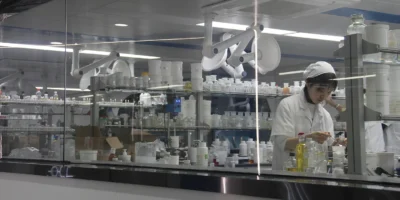
I. The Modern Transformation of Cosmetics Factories: Beyond Traditional Manufacturing
1.1 The Transformation from Labor-Intensive to Smart Manufacturing
Over the past decade, the global cosmetics manufacturing industry has undergone a revolutionary transformation. Traditional production models reliant on manual labor are being replaced by automated production lines. At a leading cosmetics factory in Seoul, South Korea, we observed robotic arms precisely performing filling, capping, and packaging tasks with an error rate of less than 0.01%. This shift not only improves production efficiency but also ensures product consistency—every jar of cream and every tube of lipstick achieves perfect uniformity.
Intelligent systems monitor the production environment in real time: temperature is controlled at 22±2°C, humidity is maintained between 45-55%, and these parameters are automatically adjusted by a central control system. A European high-end brand factory has even introduced an AI visual inspection system capable of detecting packaging flaws invisible to the naked eye, ensuring every product leaving the factory is flawless.
1.2 Data-Driven Production Decision Systems
At the heart of modern cosmetics factories lies data. Through IoT sensors, data is collected across the entire production chain—from raw material intake to finished product shipment, every step is digitally recorded. Data from a renowned Japanese cosmetics manufacturer’s factory shows that by optimizing production processes through data analysis, energy consumption was reduced by 23% and raw material utilization increased by 18%.
More importantly, this data enables factories to make accurate production predictions. By combining market sales data and trend analysis, factories can adjust production plans in advance, reducing inventory backlog. At an innovative factory in Shanghai, China, they use big data to predict product demand changes across different seasons and regions, cutting order response time from 14 days to 72 hours.
II. The Core Competitiveness of Cosmetics Factories: Dual Assurance of Safety and Quality
2.1 Quality Control Systems Exceeding International Standards
When consumers pick up a cosmetic product, they are experiencing the final outcome of a factory’s quality control system. Leading cosmetics factories implement “full-chain quality control” rather than relying solely on final inspections.
At the raw material stage, factories conduct three levels of testing: supplier qualification audits, raw material intake inspections, and stability testing. A Swiss skincare factory even performs DNA testing on every batch of natural plant-based raw materials to ensure purity and absence of contamination. During production, there are dozens of critical control points—for example, in emulsification processes, temperature control precision reaches ±0.5°C, with strict parameters for stirring speed and time, all automatically recorded by the system. Any deviation triggers an alarm.
2.2 The Science and Art of Microbial Control
The safety of cosmetics largely depends on the level of microbial control. Modern factories’ clean rooms typically meet standards of 100,000-class or higher, meaning no more than 100,000 particles ≥0.5μm per cubic meter of air.
But true microbial control goes far beyond this. The water treatment system at a French perfume factory is noteworthy: production water undergoes triple treatment—reverse osmosis, UV disinfection, and microfiltration—to ensure absolute purity. Even more impressive is their packaging sterilization process, which uses hydrogen peroxide vapor sterilization technology to achieve a sterile state for packaging materials before filling.

III. Innovation and R&D: The “Brain” of Cosmetics Factories
3.1 The Fast Track from Market Demand to Product Launch
Traditional cosmetics R&D cycles last 18-24 months, but leading factories have now shortened this to 6-9 months. This is thanks to the establishment of “open innovation platforms.”
A large South Korean cosmetics factory has established joint laboratories with research institutions such as Seoul National University and Yonsei University, sharing R&D resources and achievements. Their developed “microcapsule encapsulation technology” can deliver active ingredients stably to deep skin layers, a technology already applied in multiple high-end brands. Meanwhile, the factory has set up an internal consumer insight center, using virtual reality technology to let consumers “experience” product concepts before launch, collecting real feedback to guide R&D direction.
3.2 Pioneers in Sustainable Innovation
Environmental protection is no longer just a slogan but a core competitiveness for cosmetics factories. A German organic cosmetics factory has achieved a “zero waste” goal—100% recycling of production waste: plastic scraps are regenerated into packaging materials, plant residues are converted into compost, and treated wastewater is used for factory irrigation.
Even more cutting-edge is the application of biotechnology. An American factory uses yeast fermentation to produce hyaluronic acid, achieving 30% higher purity compared to traditional animal extraction methods while completely avoiding animal-derived risks. A Japanese factory has developed “water-free formulation” technology, reducing reliance on water resources while enhancing product stability.
IV. Four Major Trends for Future Cosmetics Factories
4.1 Personalized Customization: From Assembly Lines to Individual Exclusivity
Traditional factories focus on standardized mass production, but the future trend is “mass customization.” An innovative Chinese factory has introduced small-batch flexible production lines that can customize formulas based on consumer skin test data. By analyzing over 200 skin parameters via AI algorithms, the system generates personalized formulas with a minimum order quantity of just 100 units.
Even more advanced is the concept of “on-site instant production.” The factory has developed modular production equipment that can be installed in retail stores or beauty salons. After consumers select a formula, the equipment completes product preparation within 30 minutes. This model reduces inventory and transportation links, truly achieving “fresh manufacturing.”
4.2 Digital Twins: The Fusion of Virtual and Real Production
Leading factories are building “digital twin” systems—complete virtual replicas of physical factories. Engineers can simulate new production line layouts, optimize processes, and predict potential issues in the virtual environment. Data from a European group shows that with digital twin technology, new production line debugging time was reduced by 40%, and failure rates dropped by 60%.
This technology is also applied to employee training. New employees learn to operate equipment and handle emergencies in the virtual factory, only entering the actual workshop after proficiency, significantly reducing training costs and operational risks.
4.3 Deep Integration of Green Energy and Circular Economy
Future cosmetics factories will be energy producers rather than consumers. A Nordic factory’s roof is entirely covered with solar panels, generating over 30% of its annual energy consumption. They also recycle production waste heat for office heating, reducing overall energy consumption by 45% compared to similar factories.
The circular economy model is also deepening. A Taiwanese factory has established a “packaging recycling alliance” with raw material suppliers, where consumers can return empty containers to participating brands, and the factory cleans and reuses them. This closed-loop system achieves a 70% recycling rate for packaging materials, far above the industry average.
4.4 Transparent Traceability: Application of Blockchain Technology
Trust is the cornerstone of the cosmetics industry, and blockchain technology provides a solution. An international group has introduced a blockchain traceability system for some of its products. By scanning a QR code, consumers can view the entire chain of information: raw material source locations, production dates, batch inspection reports, logistics paths, and more—all data is immutable.
This transparency not only enhances consumer confidence but also improves supply chain management efficiency. When quality issues arise, the factory can pinpoint affected batches within minutes, avoiding traditional large-scale recalls, reducing losses, and protecting brand reputation.

Conclusion: Cosmetics Factories—The Intelligent Heart of the Beauty Industry
Modern cosmetics factories have moved from behind the scenes to the forefront, becoming an integral part of brand value. They are not only places of product manufacturing but also centers of technological innovation, guardians of quality, and practitioners of sustainable development. With advancements in artificial intelligence, biotechnology, and circular economy practices, cosmetics factories will continue to lead the transformation of the beauty industry.
For consumers, understanding the secrets of cosmetics factories helps in making more informed choices—true beauty stems from the perfect integration of technology and craftsmanship, beginning with every production step that demands attention to detail.
Looking ahead, what do you think will be the next breakthrough innovation in cosmetics factories? Will it be more extreme personalization or fully sustainable production models? Feel free to share your insights.