

Introduction: The Modern Definition and Industry Position of Cosmetic Factories
In today’s global beauty industry, valued at hundreds of billions of dollars, cosmetic factories are far more than simple “production workshops.” They are modern complexes that integrate cutting-edge technology, rigorous quality control, innovative research and development, and sustainable development principles. These factories are not only the physical spaces where products are born but also critical hubs connecting consumer demand with scientific innovation. As consumers increasingly demand higher safety, efficacy, and environmental friendliness from cosmetics, the role of modern cosmetic factories is undergoing profound transformation, becoming the core engine driving the entire industry forward.
This article will take you deep into the inner world of cosmetic factories, revealing the technological secrets, production processes, and industry trends behind them. Whether you are an industry professional, a potential partner, or a consumer curious about cosmetic manufacturing, you will gain valuable information and insights.

Part 1: Analyzing the Role of Cosmetic Factories in the Industry Chain
The Core Positioning of Cosmetic Factories in the Beauty Industry Chain
Cosmetic factories occupy the midstream segment of the beauty industry chain. Upstream, they connect with raw material suppliers, packaging material providers, and technology R&D institutions. Downstream, they interface with brand owners, distribution channels, and end consumers. This unique position necessitates that factories possess multifaceted capabilities: they must understand the scientific properties of upstream materials, discern downstream market consumption trends, and find the optimal balance and implementation path between the two.
From OEM to ODM: The Diversified Evolution of Factory Services
Traditional cosmetic factories primarily operated on an OEM (Original Equipment Manufacturing) model, producing according to formulas and specifications provided by brand owners. However, with increasing market competition and faster product iteration, more and more factories are transitioning to an ODM (Original Design Manufacturing) model, offering full-chain services from market research, concept development, formula design, sample making, to large-scale production.
Leading ODM factories not only possess advanced production equipment but have also established robust R&D teams and consumer insight systems. They can proactively provide brand clients with innovative product solutions based on market trend predictions, significantly shortening the product development cycle for brands. This shift in model reflects the transformation of cosmetic factories from passive “order executors” to active “innovation partners.”
Supply Chain Integrator: The Critical Hub Ensuring Quality and Timeliness
Modern cosmetic factories undertake complex supply chain integration functions. From globally sourcing high-quality raw materials to managing multi-tiered packaging suppliers and coordinating logistics distribution, factories must achieve a delicate balance between cost control, quality assurance, and delivery timelines. Especially in the context of post-pandemic global supply chain instability, excellent factories demonstrate strong risk resilience and adaptability by establishing diversified supplier networks, implementing precise inventory management, and adopting digital supply chain systems.
Part 2: In-Depth Analysis of Specialized Processes in Modern Cosmetic Factories
The R&D Laboratory: The Scientific Heart of Product Innovation
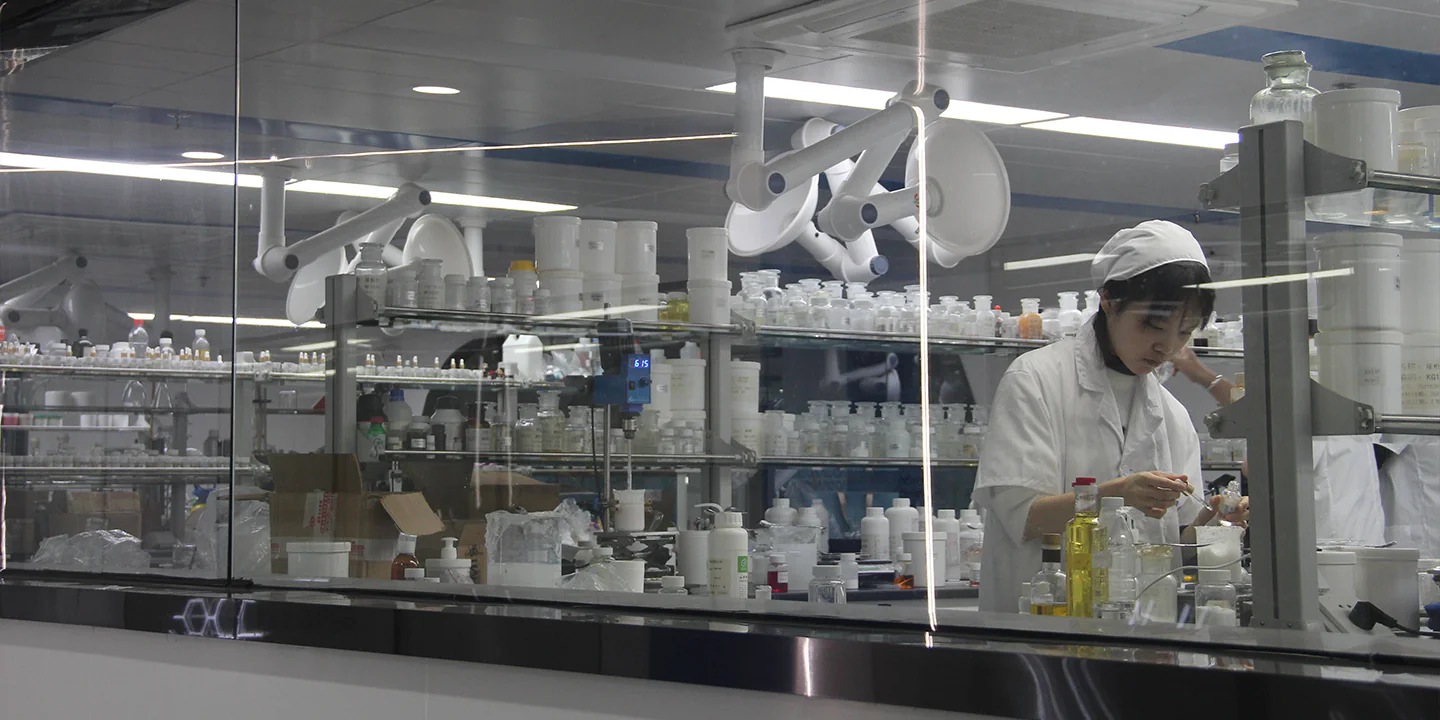
Entering the R&D laboratory of any leading cosmetic factory is often the first highlight. This is the key site where scientific principles are transformed into beauty products and a concentrated reflection of the factory’s core competitiveness.
Frontier Exploration in Ingredient Science and Formula Development
Cosmetic R&D begins with a deep understanding of ingredients. Modern factory R&D teams focus not only on the basic properties of ingredients but also delve into their molecular structures, mechanisms of action, and compatibility. They maintain close cooperation with global top-tier ingredient suppliers to access the latest ingredient technologies while also conducting independent ingredient research.
During the formula development stage, engineers must consider dozens of variables: compatibility of different components, formula stability, penetration efficiency of active ingredients, sensory feel and fragrance during use, production cost control, and the final product’s safety and efficacy. This process often requires hundreds of experimental adjustments to achieve the ideal balance.
The Rigorous Process of Efficacy Verification and Safety Assessment
“Evidence-based” has become the mainstream trend in cosmetic R&D. Leading factories establish efficacy verification laboratories equipped with advanced instruments such as skin testing devices, 3D skin models, and cell culture equipment, enabling scientific validation of product claims like moisturizing, anti-wrinkle, and whitening.
Safety assessment is even more rigorous, including multiple stages such as skin irritation tests, ocular irritation tests, phototoxicity assessments, and sensitization tests, ensuring products are highly safe for all skin types. These strict testing procedures are not only a responsibility to consumers but also a significant reflection of the factory’s professionalism.
The Production Floor: The Precise Fusion of Technology and Craftsmanship
The Art of Scale-Up from Laboratory to Production Floor
Successfully transforming a laboratory sample of a few dozen milliliters into a batch product of tens of thousands of liters is a key technical challenge in cosmetic manufacturing. This process, known as “scale-up,” requires engineers to precisely calculate scaling effects and adjust parameters like mixing speed, temperature control, and addition sequences to ensure large-scale production matches the laboratory sample in quality.
Modern factories adopt the “Quality by Design” philosophy, considering production feasibility early in the product development phase to avoid later scale-up difficulties. They use computer simulations and pilot-scale production runs to accurately predict various variables in scaled production, greatly improving the success rate and efficiency of the transition.
Intelligent Production Systems and Full-Chain Quality Control
Stepping into a modern cosmetic production floor, you will see highly automated production lines, robotic arms precisely performing filling tasks, AGVs automatically transporting materials, and central control systems monitoring every production parameter in real-time. Intelligence not only improves production efficiency but, more importantly, reduces human error, ensuring high consistency across every production batch.
Quality control runs through every stage of production: incoming raw material inspection, in-process control, and finished product inspection, forming a closed-loop management system. Many factories have obtained international certifications like GMPC and ISO22716, with quality management systems meeting pharmaceutical production standards.
Part 3: Industry Trends and Future Development
Sustainable Development: The Inevitable Transformation into Green Factories
Environmental protection has become an unavoidable responsibility and opportunity for cosmetic factories. Leading companies are advancing green transformation across multiple dimensions:
Clean Energy and Carbon Neutrality Management
More and more factories are installing solar photovoltaic panels, using green electricity, and optimizing energy management systems to reduce consumption. Carbon footprint calculation and carbon neutrality planning have become standard components of factory operations. Some pioneering factories have even achieved “zero waste to landfill” goals, transforming production waste into valuable resources through recycling systems.
Innovative Eco-Friendly Packaging and Water-Saving Production
Factories collaborate with packaging suppliers to develop recyclable, biodegradable, and eco-friendly packaging solutions, reducing plastic use. In the production process, water consumption is significantly reduced by improving cleaning procedures and recycling process water. These environmental initiatives not only lessen the environmental burden but also respond to consumer expectations for sustainable products.
Digital Transformation: The Future Vision of Smart Factories
Application of Industry 4.0 in Cosmetic Production
IoT technology enables production equipment to upload operational data in real-time, with AI algorithms analyzing this data to predict equipment failures and optimize production parameters. Digital twin technology creates virtual models of production lines to simulate and validate renovation plans before physical implementation. Blockchain technology is used for ingredient traceability; consumers can scan a QR code to learn about the origin and journey of every ingredient in the product.
Flexible Production Systems Responding to Market Changes
Market demands for small batches and high variety are driving factories towards flexible production transformation. Through modular production line design and quick changeover technology, the same production line can switch between manufacturing different products in a short time, meeting brand needs for small-batch trial production and rapid market launch. This flexibility is particularly crucial in the new consumption era driven by live-streaming e-commerce and social media marketing.
Part 4: How to Choose a High-Quality Cosmetic Factory Partner
Key Metrics for Evaluating a Cosmetic Factory
For brand owners, choosing the right factory partner is crucial. Here are several core evaluation dimensions:
Certifications and Compliance Record
Check whether the factory holds internationally recognized quality management system certifications (e.g., ISO22716, GMPC) and complies with the regulatory requirements of the target market (e.g., China’s Cosmetics Supervision and Administration Regulations, EU Cosmetics Regulation EC No 1223/2009). Historical compliance records and past regulatory inspection results are also important references.
R&D Capability and Innovation Pipeline
Understand the composition of the factory’s R&D team, the number of patents, and its collaborations with research institutions. Visit its laboratory facilities to assess whether its technological pipeline can support your product innovation needs. A factory with forward-looking R&D capabilities can provide brands with long-term competitive advantages.
Production Capacity and Supply Chain Resilience
Evaluate the factory’s equipment sophistication, production scale, and flexibility. Examine the stability of its raw material supply and the availability of backup suppliers. In an era of increasing global uncertainties, supply chain resilience has become a key consideration in factory selection.
Conclusion: Cosmetic Factories—The Invisible Champions of the Beauty Industry
As the foundation of the beauty industry, cosmetic factories are undergoing technological innovation and conceptual upgrades at an astonishing pace. They are no longer anonymous players hidden behind brands but vital forces driving industry innovation, ensuring product safety, and practicing sustainable development.
In the future, with the development of new technologies like personalized customization, green chemistry, and biomanufacturing, cosmetic factories will continue to evolve, meeting the diverse beauty pursuits of global consumers in smarter, more flexible, and more environmentally friendly ways. For brands looking to enter the beauty industry or seeking manufacturing partners, gaining a deep understanding of the internal logic and cutting-edge developments of cosmetic factories will be the key first step toward making informed decisions.
Whether you are an industry insider or a general consumer, the next time you pick up a jar of cream or a tube of lipstick, consider the modern factory—a fusion of science, art, and responsibility—behind it, and the wisdom and effort countless professionals have dedicated to that single, small product.