

In the multi-billion dollar global beauty industry, the cosmetics factory is the silent engine driving innovation. Whether it is a legacy luxury brand or a viral TikTok-born startup, the success of every beauty product hinges on the manufacturing partner’s ability to balance science, safety, and scalability.
This guide provides an in-depth exploration of how modern cosmetics factories operate, the critical standards they must meet, and how to select a partner that can turn a vision into a market-leading product.
1. Understanding the Core Business Models of a Cosmetics Factory
When engaging with a cosmetics factory, the first step is determining the level of involvement required from the manufacturer. Most professional facilities operate under three primary frameworks.
OEM (Original Equipment Manufacturer)
In the OEM model, the brand provides the specific formula, and the cosmetics factory acts solely as the production site.
-
Best for: Established brands with in-house R&D departments.
-
Key Advantage: The brand maintains 100% ownership of the intellectual property (IP) and technical specifications, utilizing the factory’s infrastructure for mass production and cost optimization.
ODM (Original Design Manufacturer)
This is a “turnkey” solution where the factory handles everything from formulation development to packaging design.
-
The “Formula Library”: Leading ODM factories maintain thousands of “ready-to-go” base formulas (sunscreen, anti-aging serums, lipsticks) that can be customized with specific scents or active ingredients.
-
Best for: New entrants or influencers looking for a rapid “Time-to-Market.”
OBM (Original Brand Manufacturer)
Some advanced cosmetics factories have evolved into OBMs, where they develop, manufacture, and market their own internal brands. This model demonstrates the factory’s full-spectrum capability, from laboratory research to consumer branding.
2. Quality Benchmarks: What Defines a Tier-1 Cosmetics Factory?
Not all factories are created equal. To ensure consumer safety and brand longevity, a manufacturer must adhere to rigorous international standards.
Global Certifications: GMPC and ISO 22716
Compliance is the non-negotiable foundation of beauty manufacturing.
-
GMPC (Good Manufacturing Practice for Cosmetics): This ensures that the production environment—including air quality, personnel hygiene, and equipment—minimizes the risk of contamination.
-
ISO 22716: An international standard that provides comprehensive guidelines for the production, control, storage, and shipment of cosmetic products.
-
FDA & EU Compliance: For brands aiming for global distribution, the factory must be registered with the FDA (USA) and meet the stringent Regulation (EC) No 1223/2009 for the European market.
Laboratory Excellence and Efficacy Testing
A high-end cosmetics factory is essentially a high-tech laboratory.
-
R&D Investment: Top-tier factories reinvest 5-10% of their revenue into research, focusing on “Clean Beauty,” “Bio-fermentation,” and “Encapsulation Technology.”
-
Stability & Compatibility Testing: Before mass production, products must undergo “stress tests” (high/low temperature cycles, UV exposure) to ensure the formula doesn’t separate or change color over time.
-
Third-Party Validation: Many factories partner with independent clinical labs to provide “Human Patch Tests” or “Efficacy Claims” (e.g., “reduces wrinkles by 20% in 4 weeks”).
3. The Anatomy of the Production Process
A professional cosmetics factory operates with clinical precision. Here is how a raw concept becomes a finished product.
Raw Material Management and Water Purification
The quality of a cosmetic product is determined by its weakest ingredient.
-
Pharmacopoeia Grade Water: Water is usually the first ingredient on the label. Leading factories use EDI (Electrodeionization) systems to produce ultra-pure water, free of microbes and minerals that could destabilize a formula.
-
Ingredient Sourcing: Ethical factories provide full traceability of raw materials, ensuring they are cruelty-free and sourced from sustainable suppliers like BASF, Symrise, or Croda.
Vacuum Emulsification: The Heart of Manufacturing
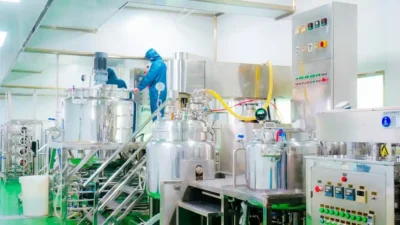
The most critical piece of equipment in any cosmetics factory is the vacuum emulsifying mixer.
-
Homogenization: This process breaks down oil and water molecules into a stable, microscopic structure, creating the “silky” texture associated with premium creams.
-
Vacuum Environment: By mixing in a vacuum, the factory prevents air bubbles from forming, which significantly extends the product’s shelf life and prevents oxidation of active ingredients like Vitamin C.
High-Precision Filling and Automated Packaging
-
Cleanroom Standards: Filling often occurs in Class 100,000 (ISO 8) cleanrooms to prevent airborne contamination.
-
Automation & AI: Modern lines use AI-driven vision systems to detect misaligned labels, under-filled bottles, or micro-cracks in glass packaging, ensuring a 99.9% defect-free rate.
4. Specialized Challenges by Product Category
Different categories require different manufacturing expertise. A “one-size-fits-all” approach rarely works in high-end beauty.
Skincare: Stability and Bio-Activity
In skincare, the challenge is keeping active ingredients (like Retinol or Peptides) stable.
-
Oxygen Control: Some factories use Nitrogen-flushing during the filling process to protect sensitive antioxidants from degradation.
-
Micro-encapsulation: Advanced factories can encapsulate actives in lipid spheres to ensure they penetrate the skin barrier effectively.
Color Cosmetics: Pigment Dispersion and Texture
Manufacturing lipsticks, foundations, and eyeshadows is an art of physics.
-
Micronization: Pigments must be ground to a specific micron size to ensure smooth application and “true-to-pan” color.
-
Color Matching: Using Spectrophotometers, a factory can ensure that “Batch A” of a foundation is an exact 100% match to “Batch B,” maintaining brand consistency.
5. 2026 Trends Shaping the Future of Cosmetics Factories
As we look toward 2026, the industry is undergoing a digital and ecological revolution.
Sustainability and Green Manufacturing
“Sustainable” is no longer a buzzword; it is a requirement.
-
PCR & Refillable Solutions: Factories are pivoting to PCR (Post-Consumer Recycled) plastics and biodegradable materials.
-
Carbon-Neutral Production: Many leading cosmetics factories are now powered by solar energy and utilize “Zero Waste to Landfill” protocols.
Artificial Intelligence and Digital Twins
-
AI Formulation: AI algorithms can now analyze thousands of ingredient combinations to predict the stability and skin-feel of a new formula in seconds, rather than months of trial and error.
-
Smart Supply Chains: IoT sensors on production lines allow brand owners to track their production status in real-time via a mobile app.
6. Due Diligence: How to Audit a Cosmetics Factory
Before signing a contract, a physical or virtual audit is essential. Use this checklist:
-
Production Capacity: Can they scale from 1,000 units to 100,000 units if your brand goes viral?
-
Personnel Expertise: Does the R&D team include chemists with experience in your specific niche (e.g., medical-grade skincare)?
-
Transparency: Are they willing to disclose their raw material suppliers and provide COA (Certificate of Analysis) for every batch?
-
MOQ (Minimum Order Quantity): High-end factories often have higher MOQs, but many are now offering “Flexible Manufacturing” for high-growth startups.
Conclusion
The choice of a cosmetics factory is perhaps the most critical decision a beauty brand will ever make. It is a partnership that blends chemical engineering with consumer psychology. By prioritizing compliance, R&D capability, and sustainable practices, brands can ensure that their products not only meet regulatory standards but also exceed consumer expectations in an increasingly competitive market.
Q: What is the typical lead time for a cosmetics factory to deliver a new product? A: For an existing formula (ODM), it usually takes 8-12 weeks. For a custom-developed formula (OEM), it can take 6-12 months due to stability testing and ingredient sourcing.
Q: Can a cosmetics factory help with trademarking and regulation? A: Most professional ODM factories have a regulatory affairs department that assists with product registration, INCI labeling, and safety assessments.
Q: What are “Small Batch” cosmetics factories? A: These are specialized facilities that cater to niche or indie brands, offering MOQs as low as 500-1,000 units, allowing for faster experimentation without high financial risk.
Are you ready to bring your beauty brand to life? Would you like me to draft a Request for Proposal (RFP) that you can send to potential factories, or perhaps a Supplier Evaluation Matrix to help you compare different manufacturing partners?